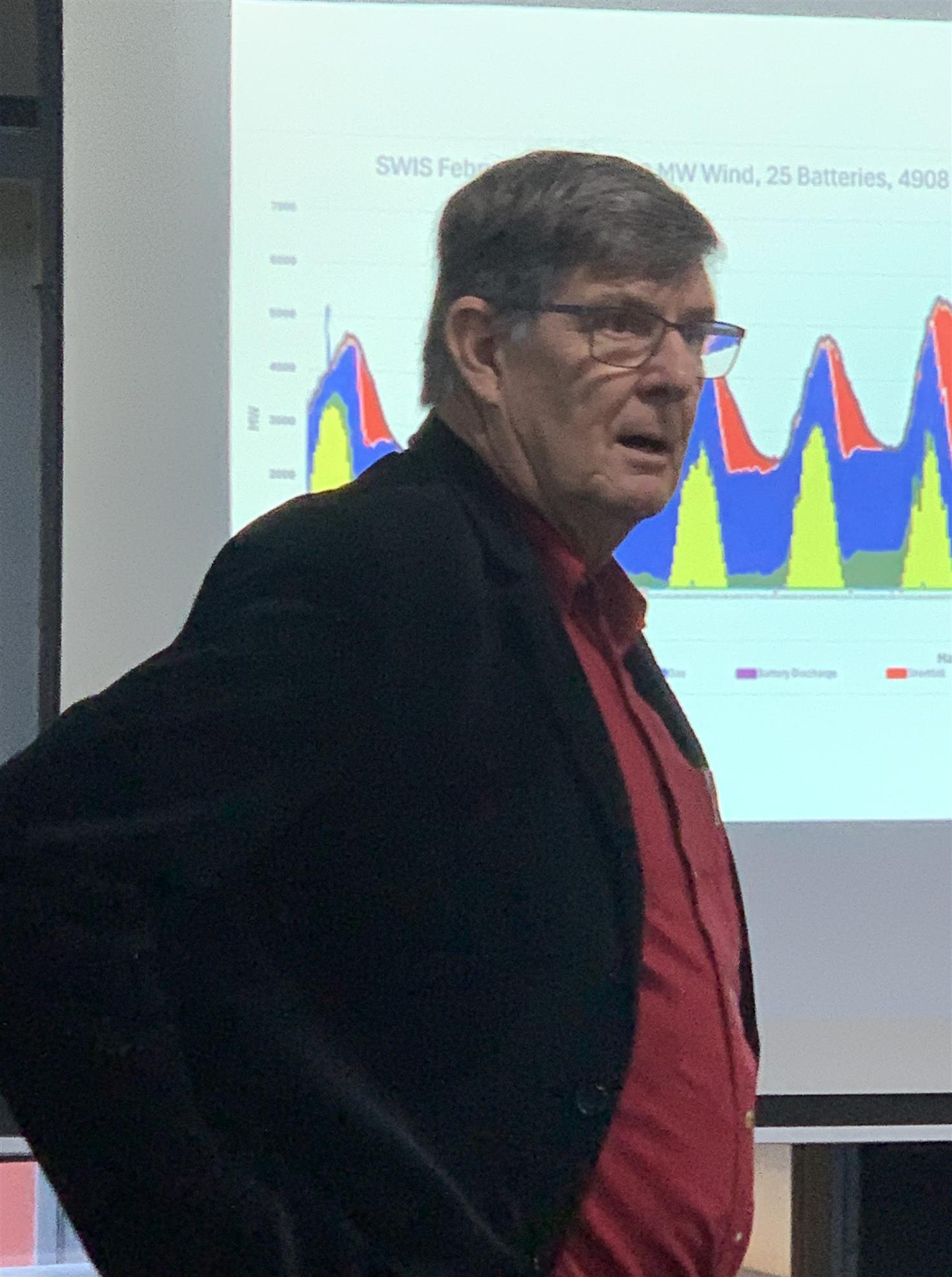
Our speaker, Mark Chatfield, is a retired electrical engineer. He joined the energy industry in 1976, and spent many years at SECWA, Western Power and as a consultant with ACIL Allen Consulting. Mark spoke of what he considers to be, a lack of planning in the energy industry in WA, particularly the South West Interconnected Power System (“SWIS”), which excludes the Pilbara and Kimberley regions. SWIS region power is generated from a combination of wind, batteries, solar, gas and coal. Power generated from wind and solar is obviously dependent on weather and sunlight although on good days roof-top solar is by far the biggest source. Power generated from gas is limited by pipeline capacity. Power generated from coal is constant (assuming coal reserves and properly maintained coal-fired power plants). Government policy is to phase out coal powered generation by 2030 and this is more a requirement based on dwindling coal reserves at Collie rather than environmental demands. Replacing this coal with imports will not help because the Collie generators are configured for Collie coal. Mark presented various forecasts of power generation and usage scenarios, based upon models he has prepared. He illustrated these forecasts by means of by means of a series of graphs. His models are based on 2024 actual power generation by source and usage, with forecasts made up to 2031, all taking into account increasing population and consumption. The models show increasing power outage periods, as coal-fired generation decreases. Mark considers failure of the system is inevitable if the current direction is maintained. The only solution is to add more gas-fired generation. If the Government does not increase gas generated capacity, it will not be able to retire the coal fired capacity. He said that nuclear power would not be an option in the SWIS region before 2040 because the system is too small.