
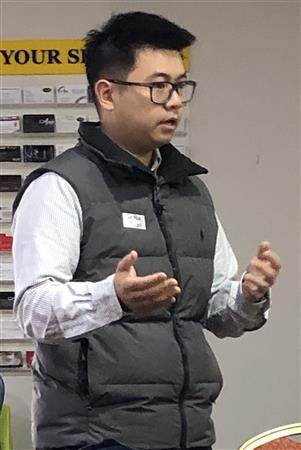
 Dr Rui ‘Chris’ Ruan, accompanied by Dr Behzad Heidari, gave us a very interesting account of the research that is taking place around the use of Mother-of-Pearl (MoP) as a natural bone substitute in orthopaedic trauma medicine. They are both with Marine Biomedical which was established in 2021 and which is the first biotech company to be founded in regional WA. The company owns patented technology called PearlBone which is a natural bone substitute made from pearl oyster shells. Pearling occurs mostly for jewellery, and so the shells are really a by-product of that process. Bone implants are the second most frequent transplant procedure, and traditional methods have often led to poor outcomes. Reconstructive surgery will be able to utilise 3 different approaches – block grafts, granular grafts, and injectable cement. The use of MoP for decorative purposes dates back thousands of years in places like China, and the Aboriginal population in Australia has used it as a trading tool over a long period of time as well. In WA MoP comes from the Kimberley region, and by 1914 Broome was supplying 80% of the demand. The quality of these shells is very high, but shells from other regions such as Indonesia have an undesirable heavy metal content. The PearlBone product still has to undergo clinical trials and to obtain necessary approvals, but good progress is being made in this regard. This year has seen the establishment of a clean room in Broome which will facilitate the production of PearlBone for use in orthopaedic applications. The success of this and other planned products will re-invigorate the pearling industry in WA, and provide patients with a very useful solution to trauma.